
Do You Need Reservations When Riding the Katy Trail?


Reservations When Riding the Katy Trail
You’re planning to ride the Katy from one end to the other.
Bike’s figured out. Gear’s packed. Daily mileage is on a spreadsheet.
Then a surprisingly important question shows up: Where are you going to sleep?
More specifically: do you need reservations, or can you ride until you’re tired and find a bed?
There’s no single answer.
Reservations When Riding the Katy Trail: A Katy trip can mean inns and vacation rentals, or a tent and campgrounds across Missouri. If this is your first time, don’t wing the overnight part.
If you’re staying indoors, make reservations
Hotels, inns, B&Bs, and vacation rentals: book the nights ahead.
That’s especially true in fall.
September and October pull cyclists, wine-country visitors, festivals, and weekend travelers into the same small towns. These are not cities with hundreds of spare rooms. A town can have several good places to stay and still not absorb a wave of riders looking for a bed at 6 p.m.
Weekends go first. Don’t assume a Tuesday or Wednesday is wide open in peak season either.
Your reservation is also your mileage plan
That’s one advantage of booking.
Overnight stops become the frame for the whole trip. You wake up knowing: today I’m riding from here to there.
For a lot of recreational riders, 35 to 50 miles a day is a comfortable touring pace. Yours depends on conditioning, weather, trail surface, how often you stop, and what kind of trip you want.
Don’t build somebody else’s itinerary. Seventy miles looks great on a map. It feels different on day four, in a headwind, after a flat.
Leave room for the unexpected.
The other reason we like reservations
You’ve been riding all day. Then it rains.
You’re dirty. Hungry. Phone’s dying. Legs have ended negotiations.
You roll into town and start calling: “Do you have somewhere I can sleep tonight?”
That’s not the adventure most people pictured.
There’s plenty of spontaneity on the Katy without making the bed one of the surprises.
What if you’re camping?
Camping changes the math. Some riders keep the itinerary loose and use town campgrounds along the route. That can be more flexible than indoor lodging.
The distinction that matters:
The Katy Trail itself is not a campground.
Katy Trail State Park is a day-use trail—open sunrise to sunset. You don’t pitch a tent on the corridor, in the right-of-way, or wherever the grass looks soft. Sleep in communities and established campgrounds off the trail.
We like to respect private property, farmers, and our neighbors, including those fascinating but unexpected slithering critters on the trail.
Rules, fees, amenities, and whether you need a reservation change by town. Some city parks allow camping. Some have real campgrounds. Some want a call or permission first.
Even if you skip formal bookings, know the night’s options before you leave in the morning.
Plan A — and Plan B
How we’d build a camping day:
Know where you intend to sleep tonight. Then name another legitimate option within a reasonable distance.
Goal: camp at Town A
Backup: campground near Town B
Emergency: indoor room in Town C
You still have freedom. You’re not depending on luck.
Verify current rules with the campground, city, or property. Listings go stale.
What about hammocks?
Hammock campers need an extra question.
A site that allows tents does not automatically give you two legal trees—or permission to hang from them. You can arrive at a perfectly fine grassy lot with nowhere to hang.
If the hammock is your sleep system, call and ask: “Is hammock camping allowed, and is there a place to hang?”
Don’t count on random trees along the trail. Don’t make stealth or unauthorized camping part of the plan. Even places with hammocks allowed have limited spaces.
A backup that doesn’t need two perfectly placed trees can save a miserable night.
Can you just wing the whole trip?
People do. Experienced tourists sometimes prefer it. They know their pace, they’ll change plans, they carry extra food and water, and they know what they’ll tolerate when Plan A dies.
For a first Katy trip, we’d plan more.
A pattern you hear from riders who’ve done it more than once:
The first trip gets planned. Later trips get improvised.
After one crossing you know the gaps between towns, which places you’d repeat, how your body handles consecutive days, and what kind of night you actually want. Trip two may look nothing like trip one.
September and October need extra lead time
If you’re riding in fall, don’t leave lodging for the week of.
Weather gets better for riding. Wine country gets busy. Towns fill with people who never touch a bicycle. You’re sharing a short supply of rooms with all of them.
If the itinerary depends on a particular town, lock that night early.
Build the trip around stops, not just miles
On a map the Katy is a line divided into mileage. On the bike you live in the towns.
Where do you eat?
Where do you refill water?
Where can you shower?
Where can you wash clothes?
Where does the bike sleep safely?
Where can you charge an e-bike?
Where do you sleep?
A good itinerary strings those answers together.
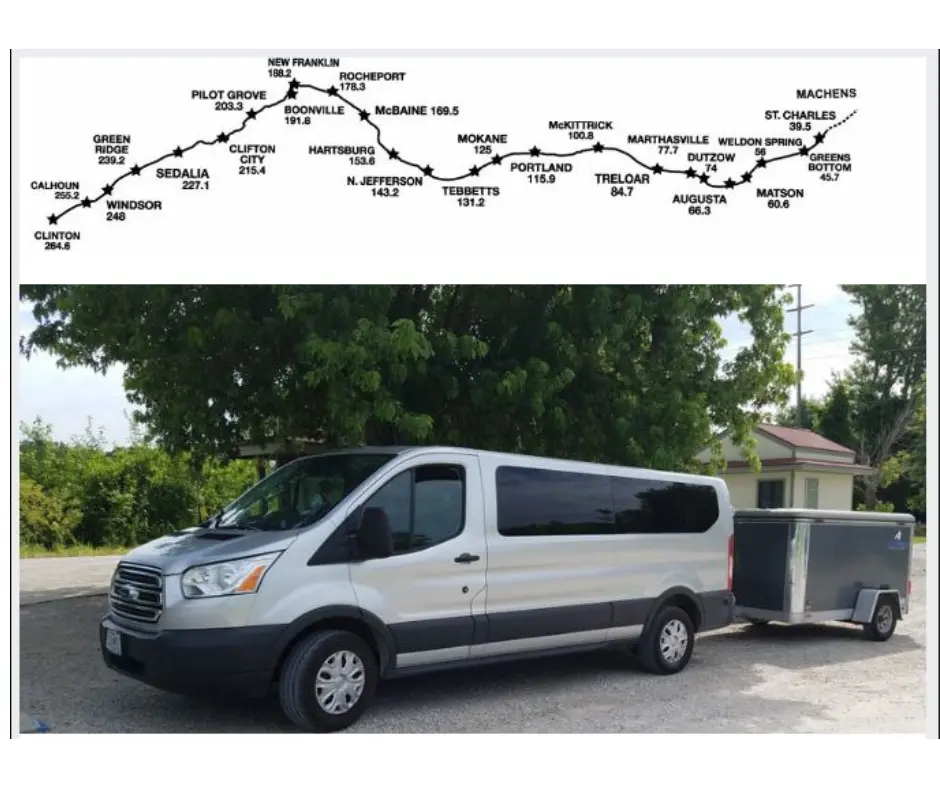
If the night lands at Mile 100.8 (McKittrick)
If the route comes through McKittrick, you roll right past us.
The Mercantile on the Katy Trail sits at Mile Marker 100.8, next to the trailhead, just across the river from Hermann. When we say we’re on the trail, we mean it.
After several days on a bike, ordinary things get wonderful: a real bed, a hot shower, a kitchen, a washer and dryer, a secure place for the bikes, a hose to wash them, an outlet for the e-bike, and a chair outside that isn’t tonight’s unanswered question.
That’s why we like hosting through-riders. We know what MM 100.8 feels like when you arrived on your own power.
The bottom line
Indoor lodging: reserve ahead, especially in September and October.
Camping: more flexible, but confirm real campgrounds and current rules. You cannot camp on the trail itself.
Hammocks: ask before you count on trees.
You don’t need to schedule every minute. You shouldn’t. Leave time for the town you didn’t expect to like, for lunch, for markers, for the stretch where you stop because Missouri looks particularly good that hour.
Try not to leave one thing to chance: where your tired head goes that night.
If one of those nights is Mile 100.8, we’ll be here at the McKittrick Trailhead.
See you on the trail.
FAQs
Do I need reservations on the Katy Trail?
For hotels, inns, and vacation rentals—yes, especially fall weekends. Camping can be more flexible if you confirm town campgrounds in advance.
Can you camp on the Katy Trail?
Not on the trail corridor. It’s a day-use state park (sunrise to sunset). Camp in towns and established campgrounds off the trail.
How far should I ride each day?
Many recreational riders use 35–50 miles. Build the day around a reserved or confirmed overnight, not a heroic number.

Comments